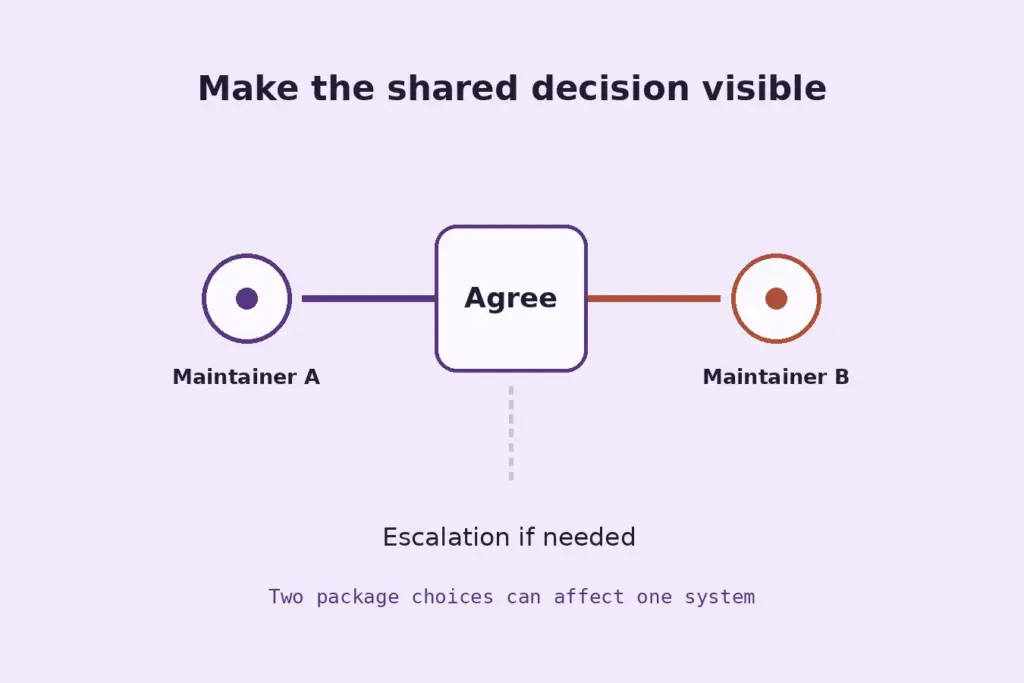
Two maintainers can each make a good choice for their own package and still leave an operating system with one bad choice. Imagine a library ready to change the name of a configuration field. Its main consumer plans to accept both names for a cycle; a smaller consumer can only handle the old name. The disagreement concerns the period when users have a mixture of old and new packages. Nobody can resolve it by being right about their own code alone.
Keep the ordinary decision close to the work
The Debian Constitution gives individual developers discretion over decisions about their own work. It also creates a Technical Committee that can decide issues where developers’ jurisdictions overlap. The process describes when this second route comes into play. The committee generally waits until attempts at consensus have failed, with an exception when the person or body normally responsible asks the committee to decide.
In the configuration example, each maintainer can first put the scenarios on the same page. Which old package versions will still be installed? Which combinations would fail in an upgrade? Can both sides name a transition condition that would let them drop the old field? A mismatch that initially looked like a disagreement about the permanent format may turn out to be a disagreement about the first upgrade.
Bring a decision the committee can make
Debian also limits the kind of work its committee does. The maintainers and their ordinary technical forums develop and discuss the options. The committee chooses among proposals or adopts a compromise between them. The useful referral therefore includes a record of the discussion, the remaining disputed condition and the choices that have actually been tried or examined.
A small project could borrow the separation even if it has three maintainers and no formal committee. Ask the people affected to produce two workable paths and explain what each costs. Name the person who will decide if they cannot agree, and preserve the final reason alongside the change. The next maintainer should be able to see why a compatibility cutoff existed before removing it. That is the value of a last-resort decision. The people closest to the work build the alternatives, and someone else can decide what the project will live with.